
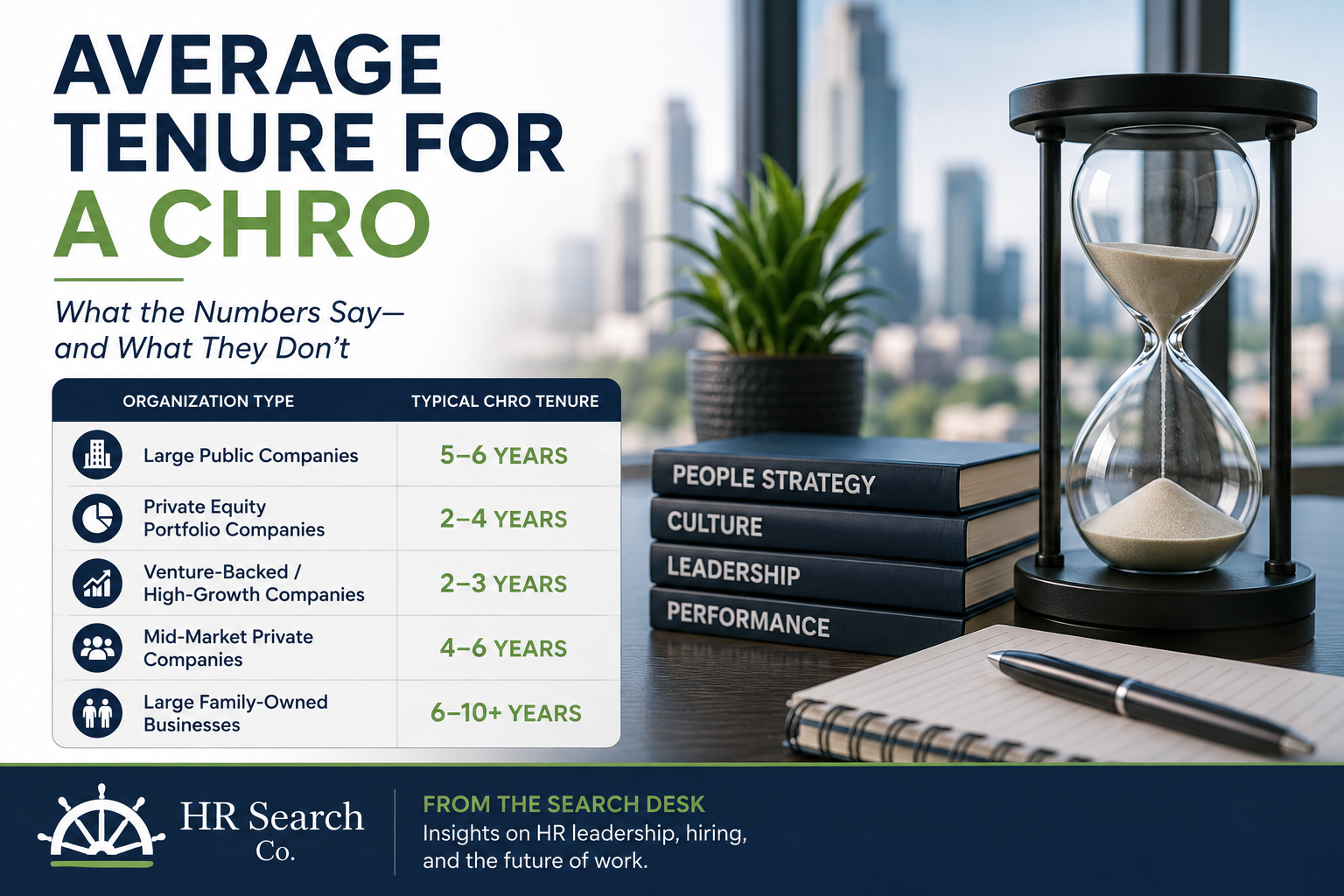
What the Numbers Say – And What They Don’t
Every confidential executive search provides a unique window into the HR leadership market. From the Search Desk is our weekly look at the trends, leadership decisions, hiring patterns, and market intelligence we’re seeing through conversations with CEOs, boards, private equity investors, and senior HR executives.
When people ask me, “What’s the average tenure of a CHRO?” they’re usually looking for a simple answer.
The published research suggests it’s around five years. According to Russell Reynolds Associates’ Global CHRO Turnover Index, the average tenure for outgoing CHROs at large public companies is approximately 5.2 years.
That’s a useful benchmark.
But it’s also incomplete.
After years of recruiting HR executives, I’ve come to believe there isn’t one average tenure for a CHRO. There are several – and they vary dramatically depending on the type of organization.
The observations below combine published research where available with real-time market intelligence gathered through my executive search work. They are intended as directional observations rather than academic research.
| Organization Type | Typical CHRO Tenure |
|---|---|
| Large Public Companies | 5 – 6 years |
| Private Equity Portfolio Companies | 2 – 4 years |
| Venture-Backed / High-Growth Companies | 2 – 3 years |
| Mid-Market Private Companies | 4 – 6 years |
| Large Family-Owned Businesses | 6 -10+ years |
Why the Difference?
One of the biggest misconceptions about HR leadership is the assumption that every company should expect one CHRO to successfully lead every chapter of its evolution.
That’s rarely how businesses operate.
A private equity-backed company preparing for operational transformation needs a different HR leader than one preparing for an exit. Likewise, a founder-led business scaling from 300 employees to 1,500 employees often requires capabilities that differ from those needed during its earliest stages.
The role changes because the business changes.
Why Private Equity CHROs Often Have Shorter Tenure
Private equity provides perhaps the clearest example.
Many portfolio companies intentionally hire HR leaders for a specific phase of the investment cycle.
That phase may include:
- Building the HR infrastructure
- Sophisticating the HR function
- Supporting acquisitions and integrations
- Driving operational improvements
- Recruiting key executives
- Preparing the company for sale
Once those objectives have been accomplished, the organization may require an entirely different leader.
That shorter tenure isn’t necessarily a reflection of poor performance.
In many cases, it’s exactly what everyone expected from the beginning.
Longer Doesn’t Always Mean Better
It’s tempting to assume longer tenure automatically equals greater success.
It doesn’t.
Some CHROs remain in their roles for a decade because the company is stable, leadership is aligned, and the business continues to evolve in ways that match their strengths.
Others leave after only three years because they successfully completed the mission they were hired to accomplish.
Without context, tenure is just a number.
The Better Question
Rather than asking,
“How long should a CHRO stay?”
I think CEOs and boards should ask,
“Is this the right HR leader for the next chapter of our business?”
That’s the conversation I find myself having most often with clients.
Sometimes the answer is yes.
Sometimes the company has simply reached a point where it needs a different kind of HR leadership.
Neither answer should automatically be viewed as success or failure.
It’s simply recognizing that organizations evolve—and so do the leaders they need.
Planning an HR leadership hire?
HR Search Co. partners with CEOs, private equity-backed companies, and CHROs to recruit exceptional HR leaders nationwide. If you’re planning a confidential search – or simply want to compare notes on the market -we’d welcome the conversation.