Why Now Is the Time to Rethink Next Year’s Merit and Bonus Cycle
Every confidential executive search provides a unique window into the HR leadership market. From the Search Desk is our weekly look at the trends, leadership decisions, hiring patterns, and market intelligence we’re seeing through conversations with CEOs, boards, private equity investors, and senior HR executives.
Summer is the best time to tune up a snowmobile.
For most companies, the cycle is finally over. Compensation teams have finished the spreadsheets, managers have had the conversations, employees have received their increases and bonuses, and everyone involved is probably happy to put the process behind them for another year.
That is exactly why now is the time to look at it.
Not next January, when deadlines are approaching and everyone is scrambling to get ready for another cycle. Do it now, while people still remember where the process bogged down, which steps required too much manual intervention, where managers struggled, and which parts of the process created work without adding much value.
This year, there is another reason to do it. The technology available by the time the next merit and bonus cycle arrives is going to be meaningfully different from what was available during the cycle you just completed. AI is moving quickly into HR technology, analytics, manager support and workflow automation.
The question isn’t whether you should “use AI” in compensation. The better question is much more practical: If we were designing our merit and bonus process from scratch today, knowing what technology can now do, would we build it the same way?
Start With the Friction, Not the Technology
Every compensation team knows where the friction was this year. Maybe it was gathering and validating data from multiple systems. Maybe managers spent too much time working through spreadsheets. Maybe HR spent days chasing approvals, identifying outliers, answering repetitive questions or correcting recommendations that fell outside the guidelines.
Before buying another tool or launching an “AI initiative,” document those pain points. Ask the people who actually ran the process where they lost time, where errors occurred, where managers needed the most help and which steps required work that felt unnecessarily manual.
Where AI Can Actually Help
This is where the conversation gets interesting. AI doesn’t need to make compensation decisions to materially improve the process. In fact, I would be cautious about handing those decisions over to AI. But there are plenty of places around the decision where better technology can remove work and improve consistency.
Data Preparation and Validation
Compensation teams spend an enormous amount of time getting data ready before anyone makes a compensation decision. AI can help identify missing information, unusual data, inconsistencies and potential errors before the cycle begins. That doesn’t eliminate human review, but it can make the review considerably faster.
Manager support
Managers often enter merit season with very different levels of experience and comfort with compensation. AI can help managers understand guidelines, answer routine questions and work through the mechanics of the process without requiring HR or Compensation to answer the same questions hundreds of times.
Instead of manually searching large spreadsheets for recommendations that deserve a second look, AI and better analytics can surface unusual increases, recommendations outside established ranges, internal inconsistencies and other exceptions for Compensation to review.
AI can also make it easier to see patterns across departments, locations and employee populations during calibration. The goal isn’t to have an algorithm decide who gets what. It is to give HR and business leaders better information before they make those decisions.
There is also an obvious opportunity around communication. Drafting manager talking points, FAQs, individualized explanations and other routine materials can consume a surprising amount of time. AI can accelerate that work while HR retains control over the message.
This may be one of the biggest missed opportunities. Once compensation is delivered, many organizations immediately move on. AI and modern analytics make it easier to analyze what actually happened — where budgets moved, where exceptions occurred, which managers consistently pushed outside guidelines and where the process itself broke down.
Don’t Automate the Judgment Out of Compensation
Merit and bonus decisions ultimately involve judgment. Performance, retention risk, internal equity, market position, business results and an employee’s contribution don’t always fit neatly into an algorithm.
That is particularly important as companies experiment with AI. The objective shouldn’t be to remove managers, HR or Compensation from the decision. It should be to give them better information, eliminate unnecessary administrative work and allow them to spend more time on the decisions that actually require judgment.
There are also obvious questions around bias, privacy, data security and explainability. If an organization can’t explain how a recommendation was generated or isn’t comfortable with the employee data being used to generate it, that is a pretty good indication that the technology has gone too far.
The Best Time to Fix Next Year’s Process Is Right Now
By January, it’s probably too late to rethink the process. At that point, Compensation teams are preparing for launch, managers are being trained, budgets are being finalized and deadlines are approaching.
But right now, the problems from this year’s cycle are still fresh.
Get the Compensation team, HR technology, HR business partners and a handful of managers in a room and ask a simple question: If we could redesign one part of this process before next year, what would it be?
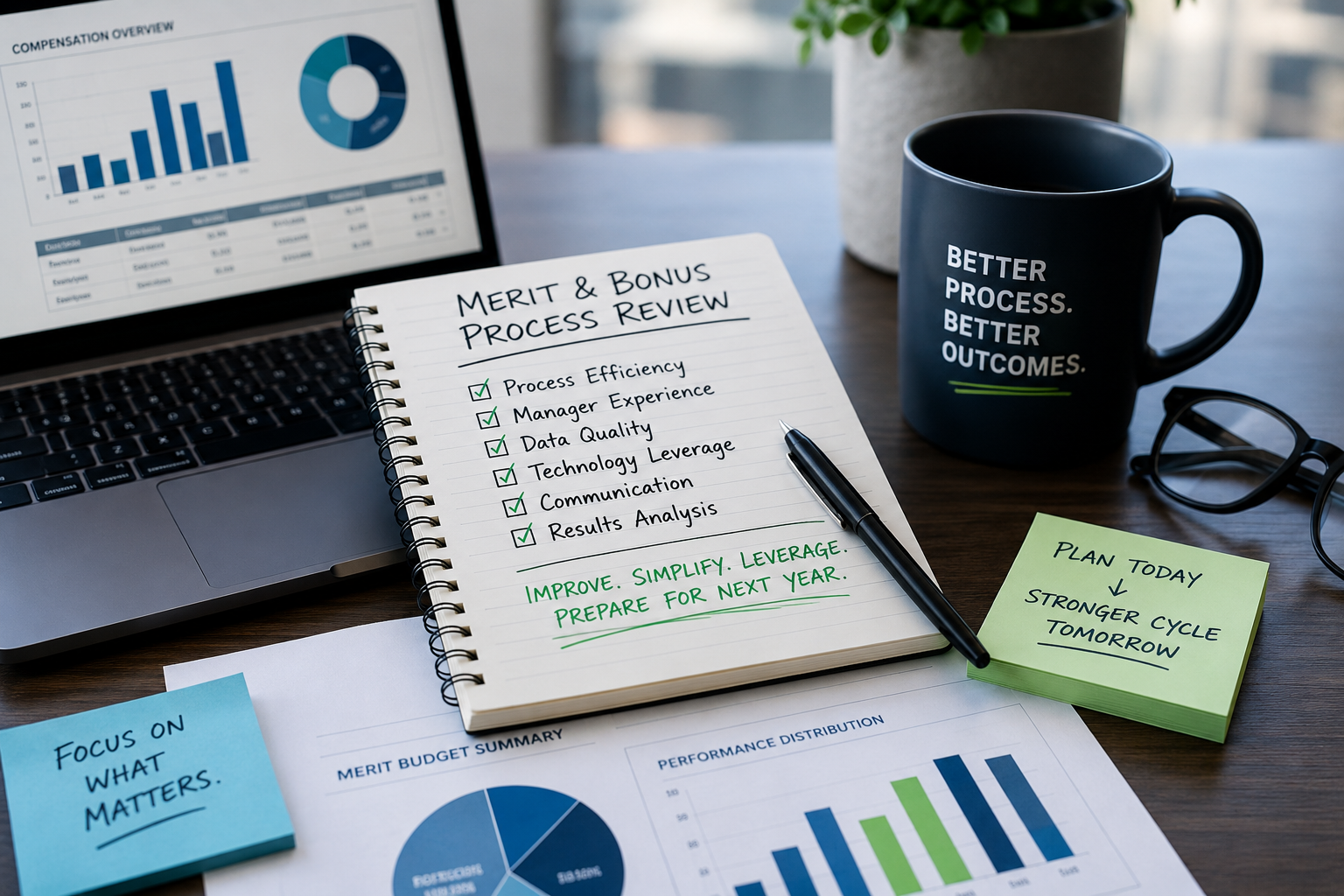
Make the list. Separate the problems that require policy changes from those that require better technology. Identify the manual work that doesn’t add value. Then look at what your existing systems can already do — and what emerging AI capabilities might allow you to do differently next year.
You don’t need to reinvent the entire compensation process.
But if next year’s merit and bonus cycle looks exactly like the one you just finished, there is a decent chance you missed an opportunity.
Planning an HR leadership hire?
HR Search Co. partners with CEOs, private equity-backed companies, and CHROs to recruit exceptional HR leaders nationwide. If you’re planning a confidential search – or simply want to compare notes on the market -we’d welcome the conversation.